THE MOTHER OF GOD
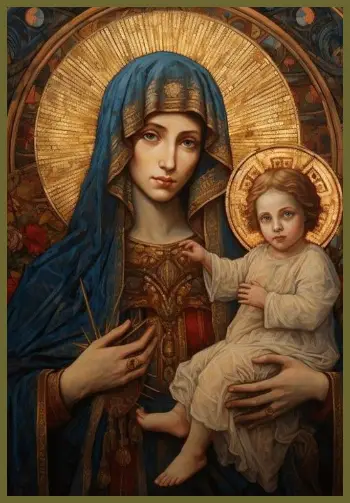
Therefore, the Lord himself will give you a sign:
The virgin will conceive and give birth to a son,
and will call him Immanuel.
Isaiah 7, 14
All this took place to fulfil what the Lord had spoken by the prophet:
“Behold, the virgin shall conceive and bear a son, and his name shall be called
Emman′u-el” (which means, God with us).
Matthew 1, 22-23
Isaiah was a prophet who lived during a tumultuous time in the kingdom of Judah, around the 8th century BCE. The context of Isaiah 7 is a political crisis in which King Ahaz of Judah (Southern Kingdom) faces the threat of invasion by the combined forces of Israel (Northern Kingdom) and Aram (Syria). Faced with fear and uncertainty, Ahaz receives a message from the Lord through Isaiah, telling him not to fear these enemies. The sign given is that a young woman (translated as “virgin” in many texts) will bear a son named Immanuel, meaning “God with us.” This sign serves multiple purposes: it reassures Ahaz of God’s presence and divine assistance during a time of crisis, and it also points towards a future hope for the people of Israel. In its immediate context, the prophecy may refer to a young woman in Isaiah’s time, suggesting that God is with His people even amid their challenges.
In the Hebrew Bible, specifically in the Masoretic Text (the authoritative Hebrew text), Isaiah 7:14 reads: “Therefore the Lord himself will give you a sign: Behold, the young woman (or virgin) shall conceive and bear a son, and shall call his name Immanuel.” The Hebrew word used here is "עַלְמָה" (almah), which typically means "young woman" and can imply virginity but does not strictly denote it. In contrast, the Septuagint (LXX), the Greek translation of the Hebrew Scriptures made in the 3rd and 2nd centuries BC, renders this Hebrew term as "παρθένος" (parthenos), which clearly means "virgin." This translation has had significant implications, especially in Christian theology, where it is often cited in discussions about the virgin birth of Jesus.
The Christian interpretation of this verse sees it as a prophetic foreshadowing of the Incarnation of Jesus Christ. In the New Testament, particularly in the Gospel of Matthew (1:22-23), this prophecy is directly linked to the virgin birth of Jesus. In the Gospel of Luke (1:28-35), the angel Gabriel announces to Mary that she will conceive by the Holy Spirit, affirming her as the virgin foretold in Isaiah's prophecy. This connection solidifies the belief that Jesus is not merely a prophet or a teacher but is the Divine Son of God, fully human and fully divine. The Virgin Mary is his mother by having conceived and borne Him.

The concept of Mary as the Mother of God (Theotokos), meaning “God-bearer,” is central to understanding her role in the Incarnation. By giving birth to Jesus, who is both God and man, Mary fulfills the prophecy of Isaiah. Her status as a virgin signifies purity and divine choice, reflecting God’s plan for salvation. Mary’s acceptance of her role, often articulated in her fiat (“Let it be to me according to your word,” Luke 1:38), underscores her faith and obedience. In this light, Mary’s motherhood is not just a biological relationship but a profound participation in God’s redemptive work. Her acceptance of this role exemplifies trust in God’s plan and highlights the mystery of God becoming human while maintaining the sanctity of Mary’s virginity.
Hence, Isaiah 7:14 serves as a vital bridge between the Old and New Testaments, highlighting God’s unwavering promise of salvation through prophecy. This verse foreshadows the miraculous birth of Jesus Christ, emphasizing the profound significance of Mary’s role in the divine narrative of redemption. By indicating that a virgin shall conceive and bear a son, the passage underscores the extraordinary nature of the Incarnation—the moment when the Word, the second Person of the Holy Trinity, became flesh and dwelled among us. This magnificent event illustrates not only the depths of God’s engagement with humanity but also the transformative impact of divine love and grace, as God took on human form to bring about reconciliation and hope for all. The intertwining of prophecy and fulfillment in this context reveals the continuity of God’s plan throughout scripture, showcasing His faithfulness across generations and the extraordinary significance of Jesus’ birth in the story of salvation.
